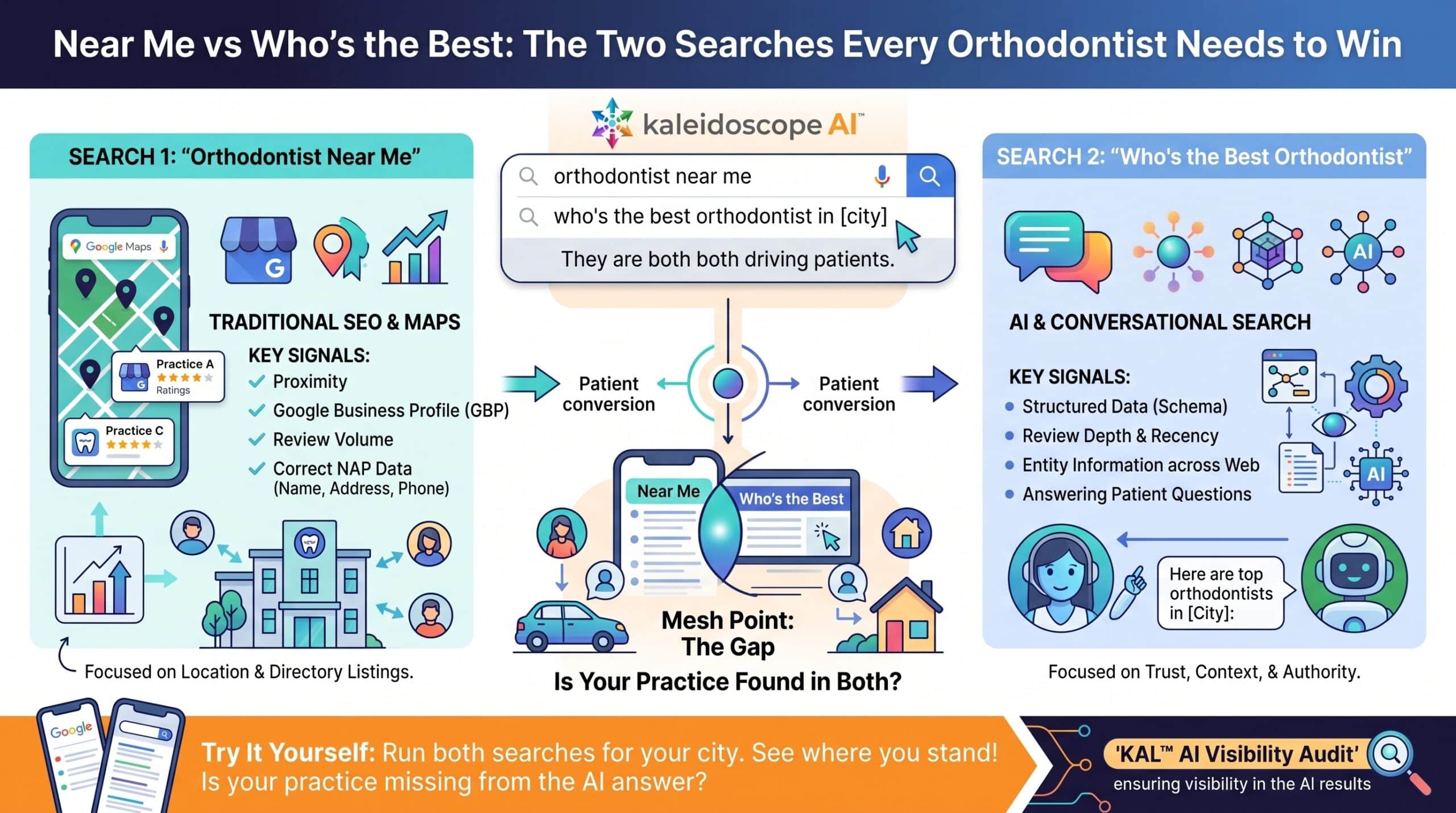
Run “orthodontist near me” and “who’s the best orthodontist in [city]” back to back for the same city, same day, and the two results barely resemble each other. That gap is not a curiosity. It is the clearest, most demoable proof of the mesh point a practice will ever see.
The Setup: Two Searches, One Parent
Picture the same parent running both searches within the same hour. First, “orthodontist near me,” typed while sitting in a parking lot. Then, later that evening, “who’s the best orthodontist in [city]” typed into an AI assistant while comparing notes with a friend.
Same person, same intent at the highest level, completely different screens looking back at her.
Why Does “Orthodontist Near Me” Still Return a Google Search?
This search still runs almost entirely on traditional SEO. A few paid ads at the top, the Google Maps three pack showing three practices with reviews and distance, then organic listings underneath. Winning it depends on the fundamentals: an accurate, active Google Business Profile, consistent name, address, and phone data everywhere it appears online, and steady review volume.
Why Does “Who’s the Best Orthodontist” Return an AI Answer Instead?
This search increasingly returns something else entirely: a direct, conversational answer naming a short list of practices, often three to five, with no map and no ads in sight. It reads less like a search result and more like a recommendation from someone who already did the homework.
If a practice is not on that short list, the honest reframe is not that they lost. It is that they were never considered in the first place. You were not passed over. You were simply never considered.
Try It Yourself
Run both searches for your own city today. Look at three things: does your practice appear in the near me results, does it appear in the AI answer, and if it appears in one but not the other, which one is missing.
If your practice is only optimized for the near me search, you are only playing half the game.
Why This Split Is the Real Opportunity
Most practices, and most agencies, are still optimizing almost entirely for the near me search, because that is the old muscle memory. Google still matters enormously, and nothing here suggests otherwise. But it means the AI conversation column is comparatively uncontested right now, which is exactly why the practices that show up there stand out disproportionately while that window is still open.