
There is no easy button.
We wish there were. A single thing you could do, one lever you could pull, and watch new patients walk through the door. But after years of working with orthodontic practices, we can tell you with confidence: that button does not exist.
What does exist is a web of interconnected marketing efforts that, when they work together, build the kind of digital presence that generates consistent growth. A strong website. Active social media. Google and Facebook ads. A well-maintained Google Business Profile. Reviews that reflect real patient experiences. Community involvement. Referral relationships with local dentists and pediatric partners. Speed to lead when someone reaches out.
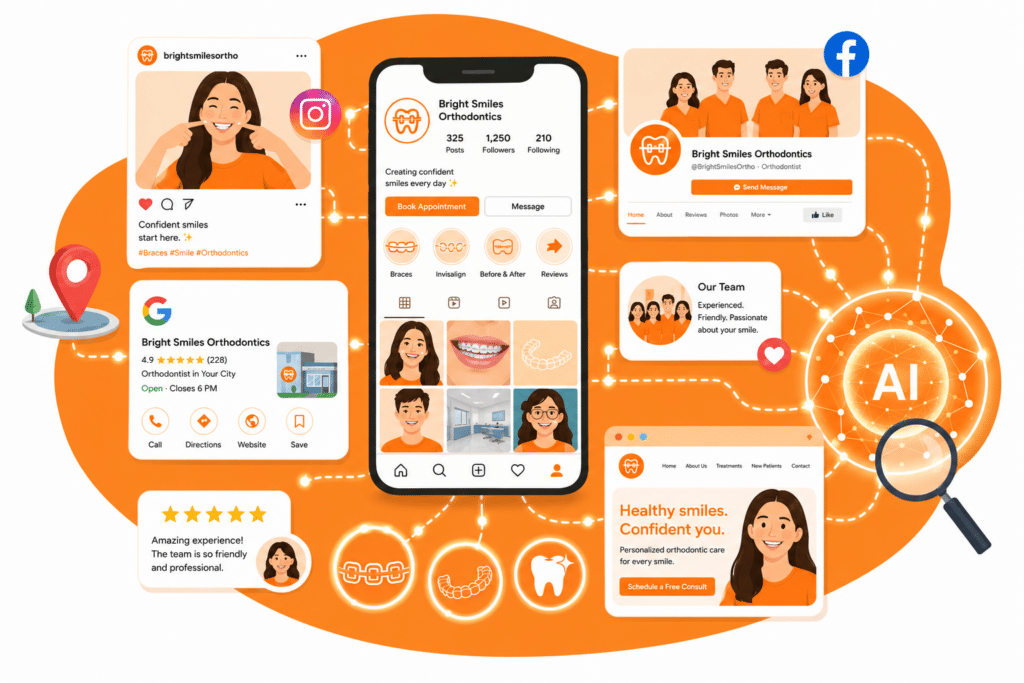
Every one of these things matters. None of them works as well in isolation.
That said, this post is about social media specifically, because something significant changed in the last year that most orthodontic practices have not caught up to yet. And if you are going to invest time and resources into posting, you should understand exactly what is now at stake.
The rules just changed
Not long ago, the case for social media was fairly straightforward. Be present. Be consistent. Show your team. Attract patients who find you on Instagram or Facebook.
That case is still true. But there is a new layer on top of it now.
AI tools are recommending local businesses to consumers. When a parent types “best orthodontist near me” into ChatGPT, asks Google’s AI Mode for a suggestion, or uses Perplexity to find someone, the AI does not simply run a Google search and hand back a list. It draws on everything it has been trained on or can currently access: websites, reviews, directories, and increasingly, social media.
Here is the part that should get your attention: in July 2025, Instagram officially allowed search engines to crawl and index public content from professional accounts. That means your Instagram posts, captions, location references, the services you mention, the way you describe your team, are now part of the web that AI tools read when deciding who to recommend.
Facebook business pages have been indexable for far longer.
So when we say AI is reading your social media, we mean it literally. The question is whether what it finds helps you or hurts you.
What AI is actually looking for
AI search tools are not browsing your Instagram feed the way a potential patient would. They are looking for signals. Specifically, they are trying to answer questions like:
Is this practice real and active? Is it located in the right area? Does it offer the services this person is looking for? Does the content across multiple channels tell a consistent story?
What this means practically is that consistency matters more than perfection. A practice that posts three times a week, mentions its city regularly, talks about Invisalign and braces, and shows a real team is sending strong signals. A practice with a beautiful profile that posted twice last month and has not touched its Facebook page in six months is sending weaker ones.
One data point worth noting: AI search tools are significantly more selective than traditional Google search. Research from early 2026 found that only about 1.2% of businesses get recommended by ChatGPT for local queries. The practices that do get recommended tend to have strong, consistent digital presences across multiple channels, not just a good website.
Social media is one piece of that puzzle. But it is a piece that is now more connected to your overall search visibility than most people realize.
There is no single tactic that carries the weight
We want to stay on this point for a moment, because it comes up in almost every conversation we have with new clients.
A startup practice asks: “Should we focus all our budget on Google Ads to get patients fast?”
An established practice asks: “We’ve been doing fine on referrals, do we really need to be posting on Instagram?”
The honest answer in both cases is: it is not about which single tactic you pick. It is about how many of these efforts you have working at the same time.
Think of it like a web. Your website anchors everything. But it performs better when your Google Business Profile is accurate and full of recent reviews. Your Google Business Profile performs better when your social media reinforces the same brand, services, and location signals. Your social media builds more trust when it looks active and human rather than dormant or generic. Your ads convert better when a prospective patient has already seen your Instagram and already feels familiar with your team.
These things feed each other. That is why a practice doing four of them well will almost always outperform a practice doing one of them brilliantly.
Social media is not the most important piece of that web. But it is a piece that affects almost every other piece, and that is increasingly true now that AI can read it.
The three types of content that actually move the needle
At KaleidoscopeAI, we think about social content in three buckets. Every practice needs all three. Here is why each one matters.
1. Products and services
These are your posts about Invisalign, metal braces, clear braces, WildSmiles, Phase 1 treatment, adult orthodontics, whatever you offer. Most practices underestimate how important these posts are because they do not get many likes.
That is not the point.
These posts establish topical authority. They tell the algorithm what your practice is about. They tell AI tools what services you provide. And they keep you showing up in the feeds of people who are already following you or have engaged with you before.
A parent who sees your Invisalign post on a Tuesday might not be ready to call yet. But three weeks later, when her daughter’s dentist suggests it is time for orthodontic treatment, your practice is the one she remembers. You stayed visible. You showed up consistently. That is what these posts do.
Do not skip them because they are not exciting. They are doing quiet, important work.
2. The human side of your practice
This is where most practices either overthink it or give up entirely.
The goal of this content is simple: when a parent visits your Instagram before calling to schedule a consultation, they should be able to answer these three questions within two minutes.
Does the doctor seem approachable? Does the team seem warm and welcoming? Is the office a place I would feel comfortable taking my kid?
That is it. You are not trying to go viral. You are trying to answer those three questions.
This does not require TikTok dances. It does not require a staff full of social media influencers. It requires showing up as a real practice with real people. Some ideas that work really well and do not require any special skills: a quick office tour (“come see where the magic happens”), a staff member showing off their favorite band color combination of the month, the doctor talking directly to the camera about what to expect on your first visit, a behind-the-scenes moment at a team lunch or birthday celebration.
Before you film anything, ask yourself: will a parent watching this feel like they already know us a little? If the answer is yes, you are on the right track.
This kind of content also does something the service posts cannot: it makes you memorable. Straight teeth are available at every orthodontic office. The experience, the vibe, the team, the energy, is specific to you. Show it.
3. Local presence and community connection
This bucket serves two purposes that feed each other.
The first is AI discoverability. When your posts reference your city, your neighborhood, a local school, or a nearby business, you are reinforcing location signals that AI uses to connect you to local searches. Mentioning “Springfield families” or “our patients from Nixa and Ozark” is not just nice copy, it is geographic context that helps AI understand where you operate and who you serve.
The second is community visibility and earned reach.
Here is a real example of how this can work. Say there is a bakery next door to your office that just opened and has a few thousand Instagram followers. You stop in one morning and grab a pastry on the way into work. You post a photo, tag them, and caption it something like: “With neighbors this good, this shopping center might need to add a gym.” Casual, warm, a little funny. There is a real chance that bakery sees the tag, shares it to their story, and now your practice is in front of three thousand people who have never heard of you before. One post. Zero ad spend.
The same principle applies offline. Sponsoring the student section shirts at a local basketball tournament does not just put your logo in the community, it gives you content. Four hundred kids in your branded shirts filling the stands? Get to the top row and take that photo. Post it. Tag the school. That is a post that does real work.
Community involvement generates social content. Social content reinforces community presence. And all of it tells AI that you are genuinely embedded in the area you serve.
What the data says
Research shows that 76% of parents and adult patients require between 7 and 10 touchpoints with a practice before they feel comfortable booking a consultation. Social media is one of the most reliable ways to deliver those touchpoints, consistently, over time, without any additional spend per impression.
Practices that combine active social media with their broader digital presence significantly outperform those that rely on any single channel. One study found that orthodontic practices integrating social signals with their local SEO efforts saw a 22% increase in organic search visibility compared to those that kept them separate.
And that research predates the Instagram indexing update of July 2025, which means the gap between active and inactive social presences is only going to widen.
How KaleidoscopeAI handles this for your practice
We know most orthodontic teams do not have a dedicated social media person. The doctor is focused on patients. The front desk is managing calls and scheduling. Nobody has two hours a week to plan, write, and post content, let alone think about whether it is hitting the right signals for AI search.
That is what we do.
Every practice we work with gets a content calendar built out a full month in advance. We write the captions. We build the graphics. We post three days a week on your behalf, mixing all three content buckets, services, team culture, and local connection, so nothing important gets missed.
We also coach your team on two additional posts per week. We write the caption and tell you exactly what kind of photo or moment to capture: a quick team selfie, a behind-the-scenes shot, something from the week that felt worth sharing. You take the photo and send it to us.
Once a month, we sit down with you, review the calendar together, and walk you through a video concept we think would land well for your practice. Something specific to your team, your market, and your moment. You film it. We edit it and post it.
This is not a shortcut. A shortcut would be posting generic stock graphics three times a week and calling it done. That kind of content does not build trust, does not show your team, does not send location signals, and increasingly does not get seen at all, by humans or by AI.
What we build is a real content presence that does actual work. One that tells prospective patients who you are before they ever call. One that tells AI tools that your practice is active, local, and worth recommending.
The practices that build this foundation now will be harder to displace a year from now. The ones that wait will spend that same year watching their more visible competitors show up in the recommendations they are not getting.
